
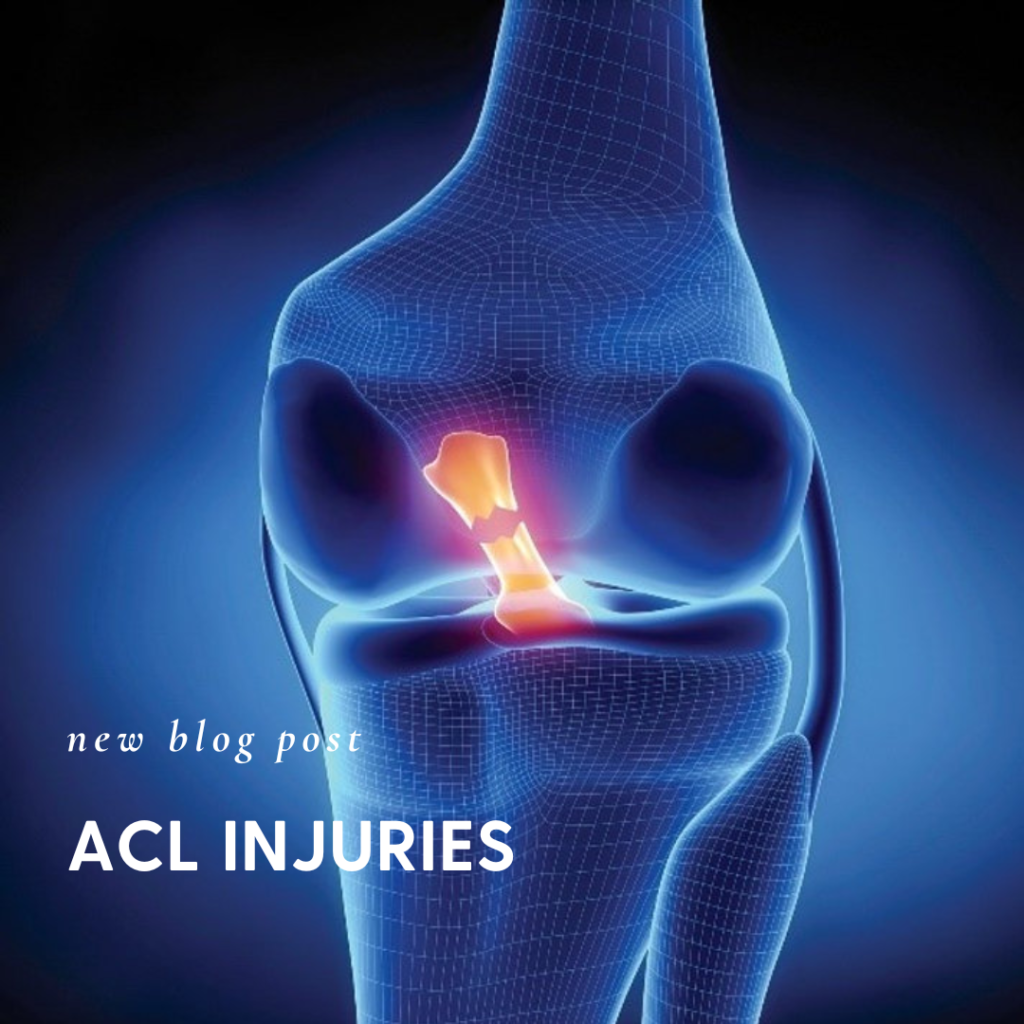
An anterior cruciate ligament, or ACL, injury is a significant knee injury—but the ligament is only one part of the recovery story. Good rehabilitation is essential whether treatment involves surgery or not.
What is the ACL?
The ACL is one of the major ligaments inside the knee. It helps control forward movement and rotation of the shin bone and contributes to stability during landing, pivoting and changing direction.
Injury may be partial or complete. The meniscus, cartilage or other ligaments can also be injured at the same time.
Typical injury pattern and symptoms
ACL injuries commonly occur during a sudden pivot, awkward landing or change of direction. A direct collision can also cause injury.
A pop or shift may be felt, followed by swelling within the first few hours. Continuing sport can be difficult, and the knee may later feel unstable or give way.
How is it assessed?
Assessment includes the injury mechanism, swelling, movement, strength and specific stability tests such as the Lachman test.
MRI is often useful to confirm the injury and identify associated damage. Early examination can be limited by pain and swelling, so the knee may need reassessment as it settles.
Early physiotherapy and prehabilitation
Initial rehabilitation controls swelling, restores full knee extension, improves bending and reactivates the quadriceps.
Manual therapy, joint mobilisation and soft-tissue treatment may help restore comfortable movement. Strengthening of the knee, hip and calf begins early, along with balance and walking exercises.
This prehabilitation can help improve knee function before a decision about surgery and prepares the person better if reconstruction is chosen.
Surgery or rehabilitation?
Some people can return to their desired activities with structured rehabilitation alone. Others may choose surgical reconstruction because of repeated instability, high-demand pivoting sport or associated injuries.
The decision considers goals, knee stability, associated damage, age, risk and personal preference. ACL injuries range in severity and in the impact they have on individuals quality of life, so there is no right or wrong answer for everyone.
We recommend almost all people with an ACL tear have a consultation with an orthopaedic surgeon as well as their trusted physiotherapist- this doesn’t mean you’ll definitely have surgery, but will help you make a truly informed decision.
ACL reconstruction replaces the ligament with a graft taken from the hamstring tendon, patella tendon, or one of several other graft sites depending on the individual.
A staged rehabilitation program
Rehabilitation progresses from swelling control and movement to heavy strength, single-leg control, running, jumping, landing and change-of-direction training.
Progress should be criteria-based rather than determined only by time. Strength, movement quality, confidence and sport-specific performance all need assessment.
Return to sport
Returning to pivoting sport often takes nine to twelve months or longer after reconstruction. Returning too early increases reinjury risk.
There is no single test that guarantees safety. A combination of time, strength, functional testing, training exposure and psychological readiness guides the decision.
The long-term goal is not simply a stable ligament- it is a strong, confident athlete with the capacity to meet the demands of their sport..